


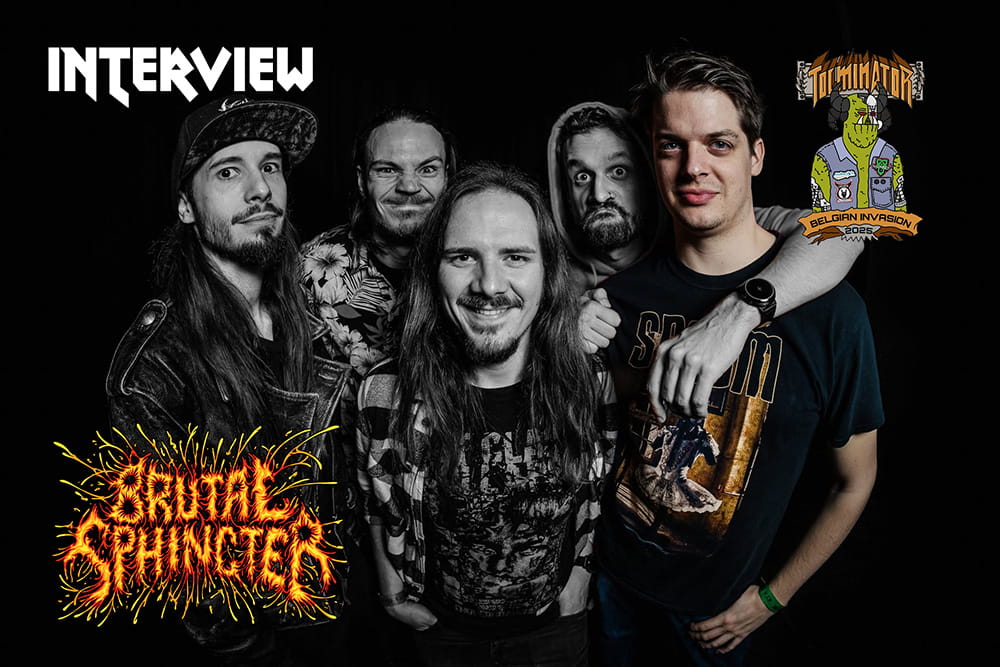
When being at Tolminator 2025 with our “Belgian Invasion”, how could we leave the festival week without having a talk with at least one of the Belgian bands on the line-up? So we met up with “Spermain” from Brutal Sphincter for a quick chat. From the moment Germain sits down backstage, one thing becomes immediately clear: getting him talking is never going to be a problem. One question effortlessly leads to another story, then another tangent, whether it’s about festival life, touring, Belgian metal, or the wonderfully absurd concept behind Brutal Sphincter‘s latest album. What starts as a conversation about returning to Tolminator quickly develops into an honest look behind the scenes of life in an extreme metal band, all delivered with the humour and self-deprecation that have become part of the band’s identity.
Before the interview has even properly begun, Germain is already laughing. When we explain that some of the younger volunteers from our youth project were originally supposed to interview Brutal Sphincter but got nervous at the last minute, he immediately waves the concern away.
“It’s okay. Honestly, I’m really easy-going… and pretty stupid, so it’ll be fine.”
That self-deprecating humour sets the tone for everything that follows. Questions rarely receive simple answers. One story effortlessly leads into another, whether it’s about festivals, touring, networking, Finnish audiences or the delightfully absurd concept behind the band’s latest album. Germain – formerly the band’s guitarist and now its bassist – clearly enjoys telling stories just as much as he enjoys playing music. Returning to Tolmin is one of those stories.
Although this marks Brutal Sphincter‘s first appearance under the Tolminator name, the band already has history with the location from the MetalDays era. Germain fondly remembers their first invitation during the uncertain Covid years, a show that eventually opened the door to returning the following year to open the festival’s main stage. Rather than dwelling on the transition from MetalDays to Tolminator, however, he prefers talking about what makes the festival special today.
“I really like the facilities here. The backstage area is nice, and I love that balcony where you can watch the whole show without standing in the middle of the crowd. The organisers really take good care of both the artists and the audience. Everyone’s genuinely welcoming.”
If anything, he believes the festival has actually benefited from becoming more intimate.
“Personally, I love medium-sized festivals. You can walk twenty minutes and you’ve crossed the whole site. Compare that with the really huge festivals where it can take nearly an hour just to get from one stage to another. As a visitor, that’s exhausting.”
He also appreciates how naturally the festival invites people to discover new bands.
“People can stop and watch a band they weren’t planning to see. If they like it, great. If not, they can just go back to the beach. I think that’s one of Tolminator’s biggest strengths.”
The conversation soon shifts from Slovenia back to Belgium, where Germain feels the country’s festival landscape offers plenty of opportunities for younger bands—provided you’re looking in the right places. While Graspop understandably focuses on attracting the biggest possible audience with internationally renowned names, he praises Alcatraz for investing in the local scene.
“Graspop naturally focuses on bringing in the biggest names because that’s what attracts the biggest audience. Alcatraz is much more open to showcasing upcoming bands. Every year they give space to around twenty Belgian bands.”
He even argues that Belgium’s location is one of the country’s biggest hidden advantages.
“When I was younger I thought Belgium was one of the worst places to have a band. Now I think it’s one of the best. Germany is next door. France is close. The Netherlands are close. Everything is nearby. Compare that with bands from Norway who often have to spend fifteen hundred euros on flights before they’ve even played a note.”
Of course, being centrally located doesn’t make touring easy. Like many underground bands, Brutal Sphincter increasingly relies on festival appearances instead of lengthy club tours.
“Winter touring is incredibly difficult financially. Most clubs either aren’t organising shows or they offer conditions that simply aren’t viable anymore. Everything costs more now. Fuel. Flights. Accommodation. Paying the musicians. It all adds up incredibly quickly. Sometimes doing a run of shows simply isn’t worth it financially.”
Despite those realities, festival season still provides plenty of memorable experiences. One of Germain‘s highlights remains Obscene Extreme Festival in the Czech Republic, which he enthusiastically describes as paradise for anyone into grindcore, slam or goregrind.
“It’s completely insane. If you love grindcore, death metal, slam or goregrind, Obscene Extreme is basically paradise.”
From affordable vegan catering to body suspension performances and other bizarre spectacles, he speaks about the festival with the excitement of a fan rather than simply another musician on the bill.
“I don’t even remember why we started talking about Obscene Extreme,” he suddenly laughs halfway through the story. “I always end up talking too much during interviews.”
Fortunately for us, that’s exactly what makes the conversation so enjoyable. Asked about Finland, where Brutal Sphincter were due to perform at Hellsinki Metal Festival just two weeks later, Germain smiles before offering an observation that anyone who’s attended concerts in different countries will probably recognise.
“They’re colder. Not in a bad way, just different. Every country has its own mentality when it comes to concerts.”
He believes Finland’s long tradition of melodic metal naturally creates a different atmosphere than countries where grindcore enjoys a stronger foothold, but it’s simply another reminder that every audience has its own character.
One of the funniest moments arrives when we ask whether playing bigger stages still makes him nervous.
“Not at all. Once you’ve already embarrassed yourself enough on stage, you stop worrying about those things.”
That immediately brings up one of the band’s recurring jokes: an infamous on-stage wardrobe malfunction. Laughing, Germain explains that although losing his trousers became something people remembered, he has no intention of turning it into a gimmick.
“It became this running joke. But honestly, I don’t want to become ‘the guy who loses his trousers’. I’m already childish enough without needing that gimmick.”
Instead, he simply enjoys embracing whatever madness festival life throws his way. That same carefree attitude also extends to networking. Rather than carefully crafting emails or trying to impress promoters through business talk, Germain much prefers simply meeting people face to face. His favourite example perfectly sums up why. Recalling how Brutal Sphincter ended up playing Motocultor Festival, he bursts into laughter.
“I met someone who was close to the Hellfest organisation. We ended up partying together on the beach, I was completely hammered, and afterwards he basically said, ‘If you’re really like this, I have to invite your band to Motocultor.'”
Ridiculous as the story sounds, it also illustrates his philosophy.
“If I recognise an organiser at a festival, I’ll just go and talk to them. That’s not me trying to manipulate anyone—it’s just who I am. If someone remembers you afterwards, then maybe, when your email eventually lands in their inbox, they’ll think, ‘Oh yes, I’ve met this guy before.’ That gives you a much better chance than just being another anonymous message.”
Eventually the conversation turns to the band’s latest album, Sphincter Society. Given the title, there really is only one logical question: where did it come from? The answer is exactly as absurd as fans of Brutal Sphincter would hope. The band regularly discusses politics, religion and conspiracy theories, eventually deciding they might as well invent one of their own.
“Our theory is that the Earth is actually one giant sphincter.”
Naturally, that also explains climate change.
“Global warming? Well, obviously that’s because this enormous sphincter is getting hotter.”
He can barely keep a straight face while explaining it. Beneath the absurd humour, however, lies a conscious musical evolution. Germain admits the new album reaches beyond pure grindcore, incorporating more death metal influences and more structured songwriting.
“We deliberately tried to expand our sound. There are more death metal influences. The songs are cleaner, more structured. For some grindcore purists that can be a difficult adjustment.”
So far, though, he’s pleased with the response.
“Overall the reaction has been very positive. Especially live. I’m really happy with how the album turned out.”
As the interview comes to an end, Germain jokingly apologises once more.
“I think I’ve already talked far too much.”
Judging by the laughter around the table, nobody seems to mind. That’s perhaps the biggest takeaway from spending half an hour with Brutal Sphincter‘s bassist. Behind the outrageous band name, outrageous jokes and outrageous conspiracy theories is someone who genuinely loves talking about music, festivals and the community surrounding them. The conversation wanders all over the place, but somehow always feels like you’re simply chatting with an old friend backstage at a festival—which, in the end, is probably exactly the kind of interview Germain enjoys most.
Links
















Leave a Reply
Want to join the discussion?Feel free to contribute!