

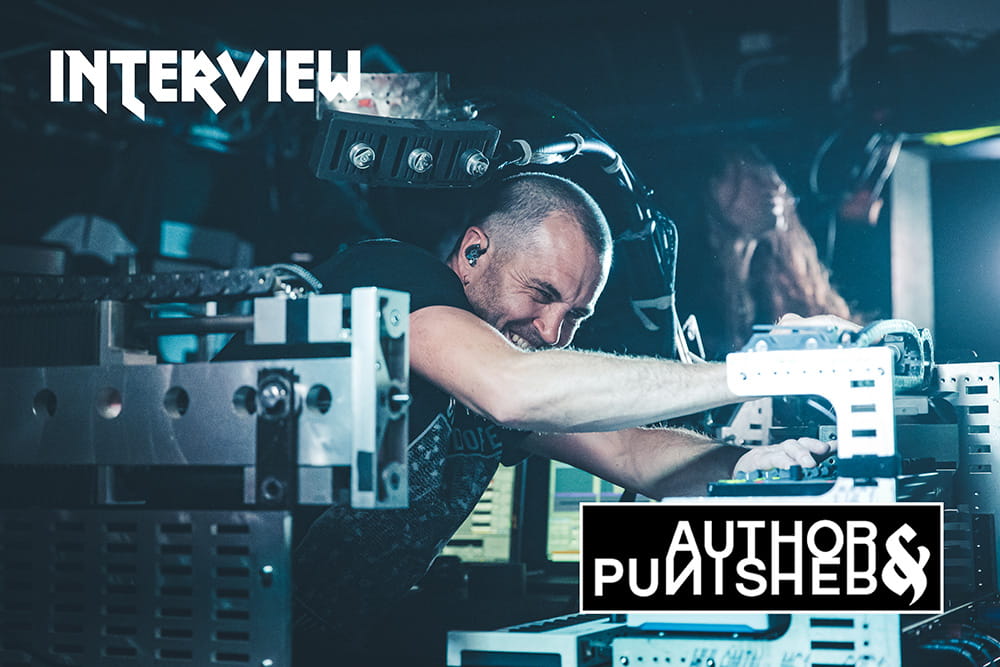
When we last spoke with Tristan Shone at Blow Up Festival in 2018, Author & Punisher still felt like a solitary experiment, one man physically wrestling sound out of machines he had built himself. Eight years later, meeting again in Helsinki, the project feels both familiar and fundamentally changed. The machines are still there. The physicality remains unmistakable. But somewhere along the way, Author & Punisher stopped being purely about isolation. It became something more human.
The Same Story — Just Further Along
Asked whether Author & Punisher now feels like a new chapter, Shone doesn’t frame things in terms of reinvention. For him, evolution happens through continuation.
“I’m always developing the same thing. Always making new stuff.”
The engineering never stopped. New controllers, new mechanisms, new performance ideas constantly emerge through his work with Drone Machines. But the most noticeable shift hasn’t been technological, it’s relational. Where Author & Punisher once existed as an intensely solitary endeavor, collaboration has quietly reshaped the project’s identity.
Control Meets Chaos
The arrival of guitarist Doug Sabolick marked one of the biggest changes since our previous conversation. Their partnership didn’t simply add another musician; it introduced a completely different creative temperament. Shone describes the contrast with a smile.
“He’s messy. He comes from psych rock… noise rock. He keeps his cables in a duffle bag and I want everything neat.”
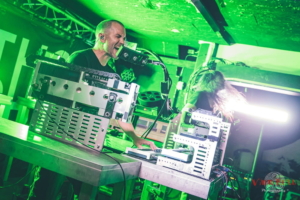
Where Shone approaches performance with engineering precision with systems ordered, movements intentional, Sabolick brings looseness and unpredictability. Instead of rigid industrial sequencing, their dynamic leans closer to the lineage of bands like Killing Joke or early industrial acts where imperfection is part of the energy. Rather than resisting that difference, Shone embraced it.
The collaboration introduced friction, movement, and melody into Author & Punisher’s sound without sacrificing its weight. Older songs even returned to the live set, finally performed together in ways that were previously impossible. Which have become highlights for Tristan to look forward to in the set, and probably the heaviest moments in the live shows. Control didn’t disappear. It learned to coexist with chaos.
Planting the Seed — Nocturnal Birding
Each Author & Punisher record begins with what Shone calls a “seed”, a starting idea that guides the entire writing process. For his latest album, ‘Nocturnal Birding’, that seed came from an unexpected place: birds.
“Every album needs a seed planted. You can’t just go into a vacuum and start writing songs.”
Birdsong wasn’t added as atmosphere. It became structural. Rhythmic and melodic patterns found in nature shaped guitar writing, arrangements, and pacing from the earliest stages. Even moments listeners perceive as deliberate thematic statements sometimes arrived through coincidence. A tribal rhythmic passage on the album emerged from a collaboration with Indonesian artists connected through a visual project, an accident that simply felt right and stayed.
What emerges on ‘Nocturnal Birding’ is industrial music guided not by machines alone, but by observation. The machine listening to nature.
Migration, Reality and Changing Perspective
The album’s thematic core runs deeper than sonic experimentation. Through volunteering with the humanitarian organization Border Angels, Shone spent time along the US–Mexico border, experiences that profoundly altered how he sees both the world and his role within it.
“It was life changing… learning about what goes down at the border. I was just all ears.”
Hiking desert trails, searching for migrants in distress, finding abandoned belongings — children’s shoes, letters, personal objects left behind — transformed migration from political abstraction into lived human reality.
“There are times when I feel this is the most valuable thing I’m doing.”
For a project once defined by industrial isolation, this represents a significant emotional expansion. The music didn’t become overt protest art, but empathy and awareness now sit beneath its weight. Author & Punisher no longer feels detached from the world. It responds to it.
When Emotion Starts Shaping the Machine
Back in 2018, Shone spoke about how the physical weight of his instruments dictated the music itself. Today, the relationship has subtly reversed. As the music became more rhythmic and collaborative, the machines evolved to match new artistic needs. Larger rotary controllers with physical detents allow faster, more precise playing, less drone, more motion.
“It’s about getting better at using these machines… now I want to play rhythms.”
Engineering remains essential, but never as spectacle. The machines exist to enable feeling, not replace it.
The Violence of Performance
Watching Author & Punisher live still feels less like a concert and more like witnessing labour. And that labour is real.
“There’s no amount of practice that prepares you except playing shows… sometimes it just doesn’t work.”
Coordination between limbs, voice, electronics and physical mechanisms pushes performance into territory few electronic artists attempt. Some nights everything aligns; others remain unpredictable. Mistakes, Shone insists, are part of the point.
“You see mistakes too. And you have to accept that.”
This philosophy extends into a blunt critique of modern electronic live culture. He rejects performances built around triggering pre-programmed elements that only simulate live execution.
“You should write the album on the stuff you actually use live. Don’t play more than you can play.”
Risk equals authenticity.
Small Rooms, Real Connection
Despite appearances on larger tours and festivals, Shone speaks most fondly about smaller venues, rooms where audiences choose to be there specifically for Author & Punisher.
“This is our audience. That still means a lot to me.”
Earlier in his career, slow growth sometimes felt frustrating. Now, perspective has shifted. Underground music surviving at all feels meaningful enough. Between shows, the focus has changed as well. Sauna visits in Finland, shared meals, moments of calm between performances — touring is no longer purely endurance. It’s something to experience while it lasts.
From Solitary Existence to Shared Burden
Having Sabolick alongside him transformed touring life beyond music. Independent touring remains physically and financially demanding. Driving, selling merch, handling gear — survival often depends on artists doing everything themselves.
“In America you have to hustle your ass off… I’m doing the work of five people.”
Burnout happens. Recovery happens at home. And yet the pull to return never disappears.
“I’m always excited about the tours. Even if I’m burned out by the end.”
Art, Media and Staying in It Together
As the conversation winds down, Shone unexpectedly turns the spotlight outward, acknowledging the fragile ecosystem surrounding underground culture.
“Thank you for folks like yourself who continue to do this… I know it’s a struggle in your world too.”
For him, musicians, journalists, promoters and listeners exist within the same shared effort — keeping art alive despite instability.
“Art and music and culture… it should be something supported. At least we’re in it together.”
Eight years after our first meeting, Author & Punisher no longer feels like one man battling machines alone. It feels like an artist learning how to carry weight collectively — through collaboration, activism, and connection. And if Shone has his way, the machines won’t stop anytime soon.
“I’m doing this until I’m seventy. We’re never stopping.”
Links














Leave a Reply
Want to join the discussion?Feel free to contribute!