

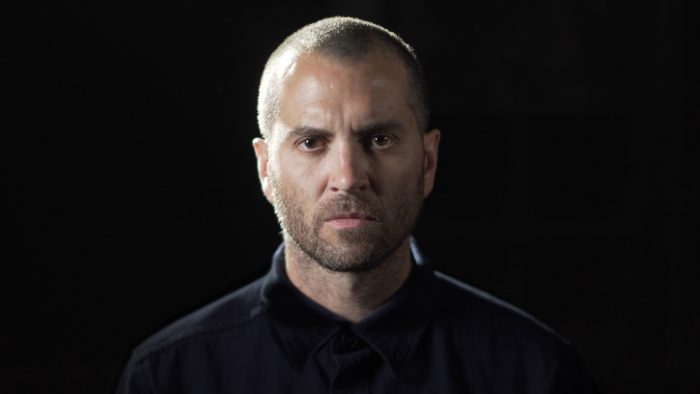
Industrial music has long flirted with machinery, but few artists embody the fusion of human and machine as completely as Author & Punisher. The project of mechanical engineer and musician Tristan Shone turns performance into physical labor: custom-built controllers, industrial hardware, and crushing soundscapes operated entirely by hand. When we meet backstage before his show at the Finnish festival Blow Up, the atmosphere is relaxed — beer in hand, jet lag still lingering — and the conversation immediately drifts toward something Shone openly prefers over written promotion: real interaction.
“I hate email interviews,” he laughs. “You send questions, I never answer them. Conversation is better.” That sentiment quickly sets the tone for an interview less about promotion and more about process, philosophy, and the strange space where engineering meets art.
From Noise Experiments to Songs
Around the time of this conversation, Author & Punisher had just released a new album that noticeably refined his sound. While earlier work leaned heavily into harsh textures and extended sonic explorations, the newer material felt more structured — paradoxically both heavier and more accessible. Shone doesn’t see it as a radical shift. “I’ve always written songs,” he explains. “But this time I worked with people who told me, ‘You don’t need that two-minute intro.’ I tried listening like a fan instead of the person who made it.” Rather than simplifying the music, the change came from discipline. He revisited his own catalogue, asking which tracks still resonated years later — and which ones he instinctively skipped.
The result became an album built on recurring rhythmic ideas and carefully refined production choices. “I found certain loops and drum patterns I loved and kept returning to them. You might not notice it consciously, but I used the same core idea across many songs and let it evolve.” The mixing process also played a crucial role. Handing the material to an external mixer forced a fresh perspective — something Shone admits took time to appreciate. “At first I thought it sounded harsher than I wanted. But after living with it, I realized… yeah, this actually works better.”
Extreme Yet Accessible
One of the most striking aspects of Author & Punisher’s evolution is how the music grew more approachable without losing brutality — something Shone himself finds difficult to explain. “I didn’t want to make a lighter record. I just wanted it intense — like those albums you can listen to all the way through.” He references formative listening experiences from the ’90s, particularly records that function as cohesive journeys rather than collections of tracks. The goal wasn’t mainstream success, but longevity: music people return to repeatedly.
Building Instruments to Build Music
Unlike most artists, Author & Punisher’s sound literally could not exist without its instruments — because Shone designs and constructs them himself. The origin story is almost accidental. After a band breakup, he returned to graduate school for art while simultaneously experimenting with drum machines, software, and sculpture. “I was building sculptures and speakers at the same time. I made a foot pedal to control my computer while playing guitar. Then I realized — these controls should feel like real tools.” That realization became the defining concept of Author & Punisher: interfaces inspired by industrial machinery rather than traditional musical instruments.
The physicality matters.
“If you program a beat, it sits perfectly on a grid. When I play it with my machines, it drags and bends like a human performance. The weight of the instrument shapes the song.” This tension — mechanical sound created through physical effort — remains central to the project’s identity. “It sounds like a machine,” he says, “but a machine can’t do those gestures.”
The State of Industrial Music
Shone speaks candidly about industrial music’s creative stagnation — a genre often trapped by its own aesthetic expectations. “Sometimes people just want it to sound industrial. That’s not really making art — but that’s fine if that’s what they want.” For him, genre should never dictate songwriting. “You just have to be a good songwriter, no matter what.” His influences illustrate that philosophy: heavy experimental bands like Neurosis, Godflesh, and Melvins remain embedded in his musical DNA decades later. “I think what you listen to between eighteen and twenty-one never leaves you. That imprint stays forever.”
Touring With Machines
While the instruments define Author & Punisher artistically, they complicate everything else. Transporting custom-built machines across continents requires multiple flight cases, specialized cabling, and technical preparation that few solo artists face. “You tell festivals: this is what it costs. Hopefully they understand what they’re getting.” When organizers do understand, the experience becomes collaborative rather than transactional — something Shone clearly values.
Collaboration — Maybe, But Carefully
Despite operating primarily as a solo project, Shone isn’t entirely opposed to collaboration. If it happens, it would likely involve vocals outside his usual sonic world. “I’d love to work with a female vocalist… maybe something more R&B or hip hop influenced. Something unexpected.” Adding a live drummer, however, feels fundamentally wrong. “We talked about that with Godflesh — we actually like the mechanical feel. A drummer would change the whole identity.” Creative independence remains essential. “I barely have enough time to do what I’m already doing.”
The Mental Weight of Performance
Watching Author & Punisher live can feel physically overwhelming — a one-man industrial machine operating at full force — but Shone reveals the performance is less physically exhausting than mentally demanding. “It’s more stressful keeping control of everything,” he says. “Switching sequences, playing parts, managing sound… if something goes wrong, it’s intense.”
When everything works, however, the experience becomes almost meditative. “I designed these instruments. When they respond perfectly, it just feels right.”
And that, ultimately, captures the essence of Author & Punisher: not technology replacing humanity, but technology shaped by it — engineered emotion forged through steel, circuitry, and persistence.
Links

















Leave a Reply
Want to join the discussion?Feel free to contribute!