

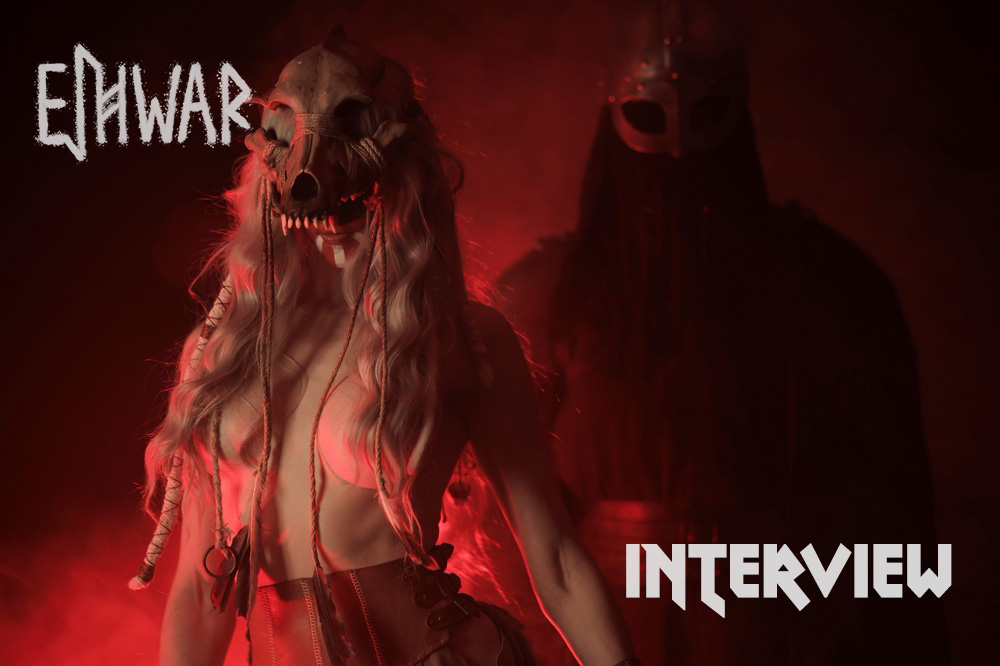
Having followed Eihwar since their earlier releases, it’s been hard not to notice how steadily the project has been carving out its own space within the pagan folk landscape. Blending ritualistic intensity with a modern, almost industrial edge, the band has grown from a more niche presence into a name that keeps appearing on festival line-ups (see the pictures of their performance at Tuska 2025 here) and tour announcements alike, drawing in an ever-expanding international audience.
With the recent release of their new album ‘Hugrheim’, a European headline tour on the horizon and a newly announced North American run, it felt like the right moment to reach out and dive deeper into the world they’ve been building.
Some bands write songs. Others build worlds.
With their newly released album ‘Hugrheim’, Eihwar go a step further, not merely crafting a concept, but presenting something that feels lived-in, remembered, and almost… recovered. What they describe is not just mythology as inspiration, but as something personal, fluid, and still unfolding. At the core of ‘Hugrheim’ lies the idea of a hidden “tenth world” within Yggdrasil, one shaped not by physical matter, but by spirit and memory. For Eihwar, this is not fiction in the traditional sense.
“Mark and I are two ‘hugir’, two spirits of Hugrheim who have incarnated in two human beings on Midgard. Little by little, our memories of the world we came from are returning to us. We lose a great deal of our memory with each incarnation. So we decided to tell our story and describe this hidden tenth world of Yggdrasil that we call home.”
It’s a striking way to frame an album, and one that immediately sets the tone for everything that follows. Rather than constructing a linear narrative, ‘Hugrheim’ unfolds as fragments, memories resurfacing, sometimes out of order, sometimes incomplete.
“We have many stories to tell. Unfortunately, with an album that has to fit into 40 minutes, we had to make choices. We decided to focus on different regions of Hugrheim (Ljósgarðr, Skuggaríki…) and on memories of past experiences there (Heill Óðinn, the Lake of the Dead…). The advantage is that since we couldn’t include everything in a single album, the rest of the adventure will be in the next one!”
Even the chronology resists structure. As Mark explains, some memories only return later, reshaping the story in hindsight. It’s an approach that mirrors the way memory itself works, unreliable, nonlinear, but deeply evocative. That same philosophy carries into the sound of Eihwar. Blending Nordic folk elements with heavy ritual percussion and electronic textures, their music doesn’t aim for academic precision or technical display. Instead, it is driven by instinct. When asked how they balance ancient inspiration with modern tools to create music, Asrunn quickly explains:
“By making exactly the music we want to hear! This project was born out of a personal and professional need. We wanted to create a danceable pagan after-party for our traveling events in France, called “La nuit des Sorcières” (The Night of the Witches). Faced with the vast emptiness we encountered, while searching for suitable tracks, we decided to create our own. It wasn’t a band project at all initially. But Odin had other plans. So we’re continuing this initial impulse to respond exclusively to what makes our heads nod and puts a smile of pure satisfaction on our faces!”
What started as a functional idea quickly evolved into something more. The foundation remains simple: rhythm, repetition, and physical response.
“Since the dawn of time, humans have entered trance states through repetitive rhythms played on percussion instruments. We keep this fundamental principle, trying to find the right balance between the absolute regularity made possible by electronics, the extremely low frequencies of kicks and electro bass lines, and organic sounds.”
That focus on physicality is key. Eihwar’s music isn’t meant to be passively consumed, it demands movement, reaction, release.
“I make sure that enjoyable simplicity remains ever-present. I’m not interested in making music to satisfy my ego. Showing that I’m a good singer, creating impressive vibes—that doesn’t interest me. That might have been the case for my human host before I took possession of her, but that time’s over, haha! The same goes for Mark and his melodies. He likes to play very complex and difficult parts on his instruments, so I always make sure to remind him that our goal isn’t to demonstrate what we can (or know how to) do, but to convey a simple, sincere and profound emotion, to give pleasure to the people who listen to us. We’re not the kind of musicians who wanted to make music for other musicians. We want to make music for people to scream, dance, jump, cry, purge everything that needs to be purged.”
There’s a deliberate rejection here of ego-driven musicianship. Complexity exists, but only insofar as it serves emotion. If a track doesn’t resonate on a visceral level, it doesn’t make the cut.
“Each track has to give us goosebumps. If it doesn’t, we start again. But generally, it’s quite fluid; we ourselves are very sensitive people, it’s hard to make cold, neutral music when you’re a living volcano.”
That same level of control and intention extends beyond the music itself. Visually, Eihwar operate in a self-contained creative universe, handling most of their imagery in-house to ensure nothing gets lost in translation. Asrunn explains:
“The more we master our entire universe, the better equipped we are to convey exactly what we want to convey. No one, however close to you, can give your vision its subtle essence. That’s why we’re always inevitably disappointed when we see a film based on a book ! It’s for this reason, and because we have the technical ability to do so, that we prefer to create all our own images. Because we know that this way we have the least possible chance of being disappointed.”
Mark adds:
“For the music videos, we still worked with six hands together with a very close friend named Samuel Morin, who is very talented. But for the rest, whether it is the promo photos, the album covers, or the illustrations, everything is indeed made in-house, often in Asrunn’s painting studio.”
It’s an approach rooted in precision, not perfectionism for its own sake, but a desire to preserve the essence of what they’re trying to express. Because for a project like Eihwar, atmosphere is not an accessory, it’s the vessel.
That atmosphere is now being brought to the stage, as the band prepares to take ‘Hugrheim’ on the road during their upcoming tour. While their performances already carry a ceremonial energy, the new material is set to shift that dynamic further.
“Mark and I wanted to give myself more freedom on stage; we felt there were too few moments where I could really come up front and sing with a microphone in hand, and dance freely without a drum. Our light designer, Yann, was also incredibly talented in preparing for this tour, enhancing the show and the connection between Mark and me.”
Combined with an enhanced visual setup, the live experience seems poised to deepen the connection between performer and audience, less a concert, more a shared ritual. And yet, for all the mythology and intensity, there’s also room for unexpected levity. When asked where they would stage the ultimate Eihwar ritual, the answer is both vivid and surprisingly grounded:
“Ah! Good question! Maybe in a place as wild as the Larzac plateau where we filmed Naudiz, with a huge bonfire and a beach nearby. When I listen to our music, it inevitably reminds me of the dance scene on Zion in Matrix Reloaded. Something like that would be really cool”
It’s a fitting image: communal, physical, almost primal. Because ultimately, that’s what Eihwar aim to create. Not just songs, not just stories, but experiences. And that comes back in every aspect of what they do. Mark explains:
“In reality, we have no ambition to speak about Norse mythology or to evolve anything. We simply recount the memories that return to us from our previous lives. These memories may come back to us in dreams… or on a perfectly ordinary morning, while eating a croissant and suddenly realizing that the comic book open in front of us reminds us of the year 912.”
Asrunn adds:
“We are to Vikings what Teenage Mutant Ninja Turtles are to turtles.”
Lastly, if someone is about to step into the world of Eihwar for the first time with ‘Hugrheim’, Asrunn had the following message about what she hopes they experience:
“The experience of complete letting go, an irresistible urge to let their body move freely, in order to access — perhaps — an altered state of consciousness, like a trance, which is something to be earned.”
In the end they thank their community of fans around the world, feeling very grateful to receive so much love.
With ‘Hugrheim’ now out in the world and the “Pagan Folk Nights 2026 European Tour” on the horizon, Eihwar invite listeners to step into that space, where memory blurs into myth, and rhythm becomes something deeper than sound.
Links










Leave a Reply
Want to join the discussion?Feel free to contribute!