
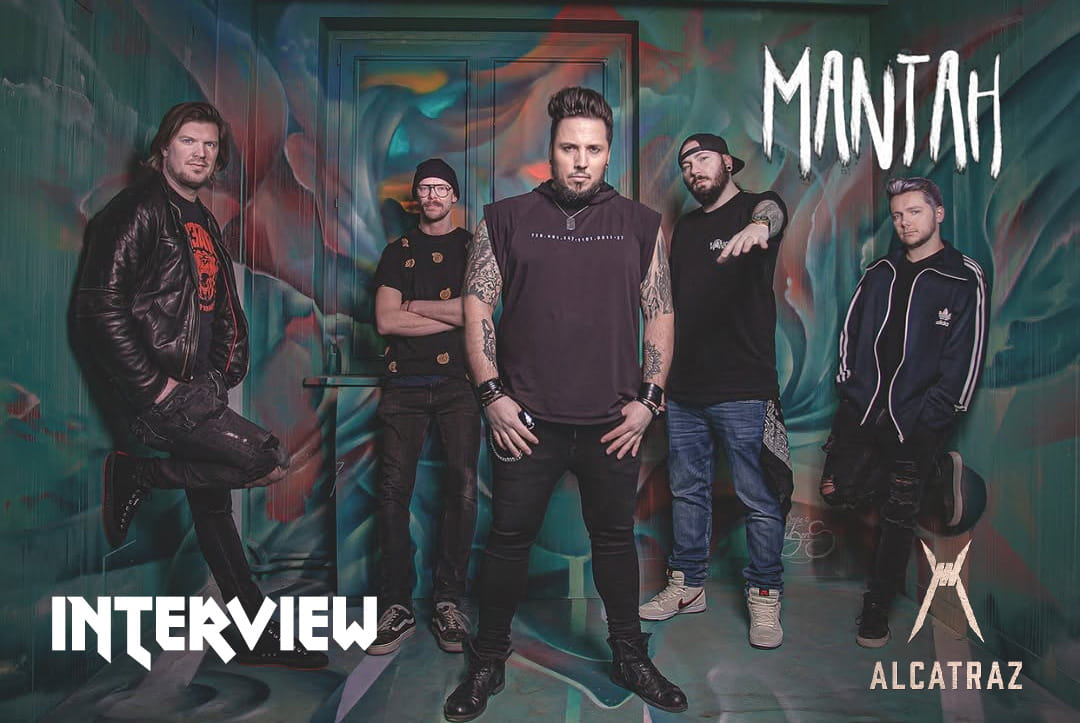
Momentum is a funny thing. One year you’re introducing yourself to the Alcatraz crowd at La Morgue, the next you’re standing on one of the festival’s larger stages with a noticeably bigger audience in front of you. That’s exactly the journey Mantah found themselves on this year, and judging by both the performance and the reception, the promotion felt more than deserved.
Catching up with almost the entire band afterwards proved just as entertaining as watching them perform. Answers were rarely given by just one person. Instead, stories bounced around the table, jokes flew back and forth, someone was always ready to contradict another member with a grin and every topic sparked a new discussion. Whether talking about the influence of ’90s metal, their evolving songwriting process, the challenge of translating live energy into the studio or the healthy state of the Belgian metal scene, one thing became abundantly clear: Mantah aren’t just a band—they’re a group of friends who genuinely enjoy creating music together, and that friendship shines through in every answer.
From La Morgue to the big stage
One year after turning heads at La Morgue, Mantah returned to Alcatraz with a well-deserved promotion to one of the festival’s larger stages. Judging by the packed crowd and the energy in front of it, the Belgian groove metal outfit proved they were more than ready for the step up. Surprisingly, though, bigger crowds aren’t what the band remember most about playing Alcatraz.
“Honestly, we don’t really care whether we’re playing for a huge crowd or a small crowd. What matters to us is the vibe. As soon as you arrive here, you feel welcome. Great people, great food, great drinks, everything is organised perfectly. It’s simply a fantastic festival to play.”
That appreciation for atmosphere would become something of a recurring theme throughout our conversation. Rather than talking about career plans or milestones, Mantah repeatedly steered the discussion back towards what simply makes playing music fun.
Not recreating the nineties
Although listeners often point towards the band’s obvious ’90s influences, Mantah never set out to become a nostalgia act. Instead, the idea was to take the music they grew up with and reshape it into something that still feels fresh today.
“When we started the band we said to each other: let’s take the music we loved growing up and make it our own. We never wanted to simply recreate the nineties. We wanted to bring those influences into something that still sounds like us.”
That philosophy perhaps explains why Mantah manage to sound both familiar and modern at the same time. Heavy riffs remain firmly rooted in metal, while melodic vocal lines often take the songs in unexpected directions. The rest of the band can only laugh when the conversation turns towards their vocalist. Years before Mantah existed, people were apparently already telling him exactly where he belonged.
“Your vocals are way too harsh for this band. You really should be playing in a metal band.”
Turns out those people had a point.
Leave room for surprises
One thing quickly became clear during our conversation: Mantah don’t write songs according to a formula. While plenty of metal bands begin with a crushing guitar riff and build everything else around it, Mantah deliberately leave space for ideas to develop naturally. Sometimes a riff comes first. Sometimes it’s a vocal melody. Whatever serves the song wins.
“Sometimes a song starts with a riff. Sometimes somebody suddenly comes in with a vocal melody. If it’s a great melody, we’ll build the song around that instead.”
That freedom also means nobody is too precious about their own ideas. Songs constantly evolve during rehearsals, with every member adding small details that weren’t originally there.
The Sleep Token debate
Every good band interview eventually descends into friendly disagreement, and this one was no exception. When the conversation turned towards experimentation in modern metal, Bart (guitar & backing vocals) jokingly accused Dennis (guitar):
“He hates Sleep Token.”
The accusation was immediately met with laughter before Dennis defended himself.
“That’s not true! I think they’re a great band. They’re fantastic musicians and they’re doing something genuinely interesting. It just doesn’t really appeal to me personally. I naturally gravitate more towards old-school death metal, bands like Carnation.”
His conclusion, however, was one everybody around the table agreed with.
“Bands like that are important. They bring fresh ideas, and sooner or later other bands take those ideas somewhere else. That’s how music evolves.”
It perfectly summed up Mantah‘s own philosophy. Personal taste is one thing; respecting creativity is something else entirely.
When songs start living their own lives
Ask Mantah about their upcoming second album and you’ll quickly discover they’re not interested in reinventing themselves. Instead, they want the next record to sound more like the band they’ve become after spending months performing together.
“You write the songs, record them, and then after playing them live for a year they become something else. That’s what we want to capture now.”
Bart explains how live performances naturally introduce new guitar harmonies, little embellishments and spontaneous moments that eventually become inseparable from the songs themselves. Those are exactly the details they hope to preserve when recording album number two.
The writing process itself is also well underway. While the band are deliberately taking their time, they reveal that plenty of new material has already been written. Rather than chasing a deadline, the focus is on refining those ideas and making sure the second record captures the same chemistry that has become such a defining part of their live shows.
2025, they explain, will largely revolve around balancing recording sessions with live performances before unleashing the new material on stage.
One Belgian metal family
As the interview came to an end, Mantah unexpectedly stopped talking about themselves altogether. Instead, they wanted to shine a spotlight on the wider Belgian metal scene and on festivals like Alcatraz that continue giving homegrown bands opportunities.
“I’d just like to thank Alcatraz for supporting Belgian bands. They came to our album release show and a week later we received an email asking us to play the festival. Things like that are incredibly important for local bands.”
That naturally evolved into a broader conversation about Belgian metal as a whole with comments by almost every member that very much aligned with each other:
“There really isn’t much competition anymore.”
“It’s one community.”
“I actually notice that the bigger bands are often the most supportive.”
Perhaps the final thought of the afternoon captured it best.
“Maybe twenty years ago there was more competition. Today it doesn’t feel like that anymore. It’s just one community, and hopefully it stays that way.”
Links










Leave a Reply
Want to join the discussion?Feel free to contribute!