

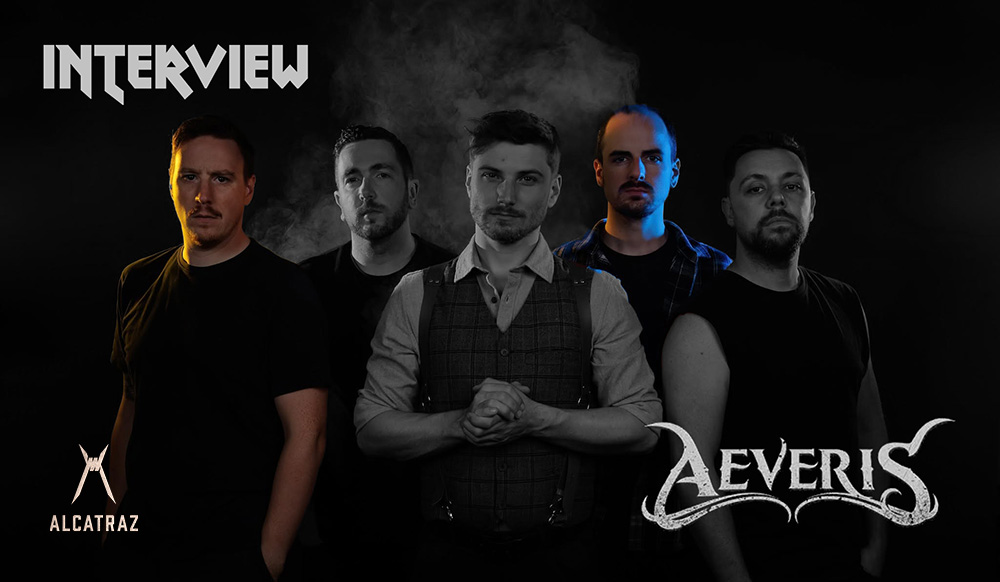
Fresh off the stage at Alcatraz Festival, Aeveris’ Jeffrey (guitars) and Louis (drums) joined us for a chat about the story behind their name, the deeply personal themes running through their latest album ‘Imminence’, and how the band’s evolving lineup has changed the way they create music together. With the album dealing with loss, masks, emotional struggles and their consequences, the conversation also touched on the importance of making those emotions feel genuine rather than simply writing lyrics for the sake of a story.
There was plenty of lighter conversation too, including the rather amusing coincidence of Swedish metalcore band Imminence appearing on the same festival stage on the very same day. As Louis joked, perhaps Aeveris’ album was simply “so cool, they made a band for it.” We also talked about pre-show nerves, the challenge of being an overly analytical musician, dream festival stages, and why, ultimately, a live performance should be about more than getting every detail perfect.
GRIMM:
Welcome Jeffrey and Louis. Thanks for taking the time to chat.
During the show, it was playfully mentioned that Aeveris is pronounced with the “E” from “Bert”.
Jeffrey:
We have been on the radio a few times and we noticed that there’s some confusion. So we thought, we’ll just clear that up.
GRIMM:
Aeveris comes from Avarice, which means greed. What is your special connection with the word?
Jeffrey:
It was actually a word I always thought was cool. And it does mean something, so I liked that. I just thought writing Avarice the normal way was a bit of a shame. So I thought, what if I just write it phonetically. That happened back when I was with the previous guitarist in London. I wrote it down and thought it looked pretty cool. I showed it to Dennis back then, and he said “this is actually it.” So that’s how it actually came about. There’s no special connection with the word greed per se.
GRIMM:
You want to carry a theme of mental well-being to the audience with the album ‘Imminence’. You draw this from your own experiences. May I be so bold as to ask for an example or a situation of that? Or is that too personal?
Jeffrey:
That’s definitely not too personal. At first, it was a bit time-bound that we had to release it in two parts. But I thought it would be really cool to make a theme out of it that we then released in two parts. It’s actually Wouter who fully developed that concept. So if you’d like personal anecdotes, you’d have to ask Wouter. He really wrote from his own experiences, but they are universal themes, of course.
It’s about loss, it’s about how you deal with people who put on a mask and then just keep taking, taking, taking. And then in the second part, you see the consequences of that. When those masks fall off, what then?
GRIMM:
I hear you saying that Wouter mainly draws from those experiences. Is it mostly Wouter who writes the lyrics or the music? Or how does that process work with you guys?
Louis:
The music mostly comes from him, actually. Jeffrey usually writes and he comes up with riffs together with Dempsey. And then you kind of have a rough version of the song. He sends that to us and then Wouter writes the lyrics. We do give feedback on what he wants to do with them. But the themes, that mainly comes from Wouter. And then the songs get built up from there. I write my drumline over that. Usually I program it in MIDI first, because not everything is playable right away, I want to have it programmed first to listen to it. We fine-tune it throughout the whole process. We haven’t really had much influence on what Wouter wants to sing. We mostly leave that up to him.
Jeffrey:
Like Louis said, I make it. But that doesn’t mean I’m some dictator who says “this is how it is and it’s going to stay that way.” Not at all. I really like when people contribute to it. Because then the songs become ours, not just mine, which is really important. And I think it’s very important that if Wouter has to sing it, he sings about something he truly believes in so that the emotion also comes across to the audience. In feedback, we can tell that it does come across because those emotions are real.
Louis:
If I talk about a problem I experienced when I was twelve, and I write a text about it and have him sing it, he’ll be able to sing it, but if he hasn’t experienced it, there’s less connection to those emotions. That’s why it’s also good that these are things he’s struggled with himself. Of course, that’s not so great. Everyone experiences things. I think he did it really well. In the A part and the B part, it’s question and answer. Cause and effect, actually. That’s the difference between the two parts.
Jeffrey:
The first two parts are all the problems you can encounter. The second part is the consequences. That was put together in one album.
GRIMM:
Coincidentally, a band called Imminence is playing tonight. They’re performing tonight as well. Are you guys going to check them out?
Louis:
We’ve already joked that our album was so cool, they made a band for it.
Jeffrey:
When Wouter and I were talking about it, I looked it up and said, “We’re never going to see a band from Sweden here.” And now they’re here. Coincidentally on the same day and on the same stage.
Louis:
I’m going to check it out. I can just stand there waving our album around the whole time.
GRIMM:
Has the group dynamic changed a lot for you guys with the arrival of Wouter and Dempsey? In terms of process and vibe?
Louis:
I think for me it’s more about the collaboration. There’s always been room for input, but now I feel like that room is even bigger. And we can work on the songs and finish them more as a band.
Jeffrey:
We had to share Dennis with Mantah. That was never a problem and Mantah is doing really well. He just didn’t have enough time anymore and he also thought it was annoying. He made the decision to fully go for Mantah. We still get along really well. The first album was mostly written during corona. The songs were already made before everyone came together.
Louis:
Then Louis (original vocalist) left, followed by Dennis. Then we had to figure out for a long time what we were going to do. Louis made the artwork for our album, so we’re still in good contact with him. I now feel like everyone is 100 percent committed and that we’re dedicated.
Jeffrey:
We found Wouter. Totally by chance. He took part in the Ideale Wereld Cover Contest, The Voice, and Reggie’s Academy. He had signed up for fun and got really far in all of them. And at some point, we had to look for a new singer. I was scrolling through Facebook, checking out everything and everyone. I came across Wouter with his The Voice photo. I sent him our call that had already been launched. He had actually already submitted an entry.
Louis:
We sometimes joke that Wouter is a golden retriever. That guy is so enthusiastic and super reliable.
Jeffrey:
But now with a new album coming. We’ve already been working on it a bit. Wouter has a lot more input. He’s much more available.
GRIMM:
Would you ever be asked by another band to play with them? Which band would you be honored by?
Louis:
I sometimes fill in here and there. Recently, I had to fill in for Carnea as well.
But recently there was that young guy who filled in for Gojira, that’s insane. It’s not realistic, but Gojira is the first thing that comes to mind. And Meshuggah. Tremonti, I think that’s super cool too. I’m already honored that I got to play here today with these guys; for us, that’s our biggest stage.
Louis:
My whole life, my dream has been to play at Graspop. Red Rocks in Arizona is the place I’d most like to perform.
GRIMM:
What do the last ten minutes before your performance look like for you? Do you have a routine, individually or as a group?
Louis:
For me, it’s mostly trying to calm down and focus. Paying attention to my breathing because I notice my heart rate going up. Mainly telling myself to enjoy it. Not focusing on it being perfect.
Jeffrey:
The problem is that Louis is a musician, through and through. He also plays for musicians. And that’s the toughest audience. He knows there will be drummers who will watch what he does with a certain eye.
Louis:
I’m too analytical. When you’re behind that instrument and you know what you want to do, you want to express that. You have to learn to disconnect from that, so you’re not analyzing every tiny thing. For me, those last ten minutes are about trying to get into the mindset of just enjoying it.
Jeffrey:
I hate that—static music and performances. In the end, we’re all entertainers. And you come to the show to be entertained. We’re all in our own zone, and then you see us all in our little square: walking around, breathing.
A fist bump at the last moment for the group vibe.
GRIMM:
What happens after performing to unwind?
Jeffrey:
Today it was hugs.
Louis:
Today went quickly because of the schedule and cleaning up. We also had to do a signing session and the cars had to go. I do find peace in taking things down.
Jeffrey:
I can be structured if I have to. Otherwise, you wouldn’t make songs or albums either.
Louis:
Preferably, I first take half an hour to meet with the group. Analyze if it went well, whether we need to adjust the linking texts, and go over if the audience enjoyed it.
Jeffrey:
I also think that the people who have been following us from the start can see that evolution as well.
GRIMM:
Is there anything I haven’t asked yet that you want to share?
Jeffrey:
I want to thank you all. Everyone who is reading this. Check out our album and come to shows. Thanks already for listening and to those who are already supporting us. Thank you for taking the time.
Links
















Leave a Reply
Want to join the discussion?Feel free to contribute!